



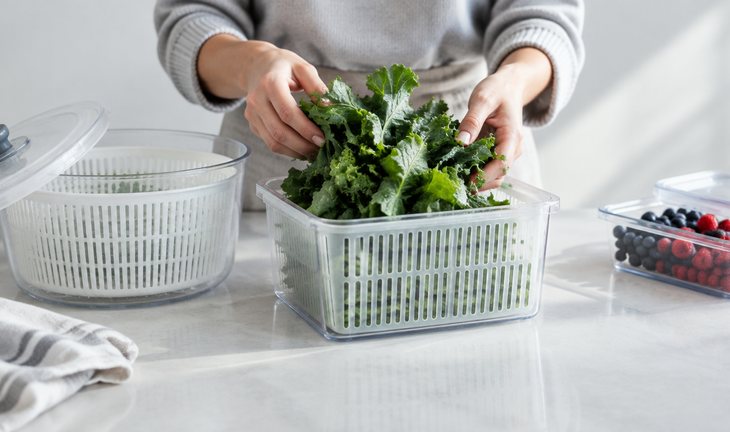
The produce you throw out was bought with the intention of eating it. That is what makes it frustrating. Nobody plans to compost half a clamshell of raspberries, and yet the bag of greens that looked fine on Tuesday is unusable by Friday more often than anyone would like to admit.
Most of this is solvable, and very little of it requires buying anything. Good apartment food storage comes down to three things. Where you put something, how dry it is when you put it there, and whether you remember it is in there at all. The containers help, and a few of them help a lot, but they work best on top of the habits rather than instead of them.
Start with the refrigerator you already have.
Put Things Where the Fridge Wants Them
A refrigerator is not one environment. It is four or five, and most of us use it as though it were one.
The door is the warmest part and the part that swings through a temperature change every time you open it. It is the worst place for milk and eggs, which is exactly where most refrigerators put the molded shelf for them. Move those to the middle shelf and give the door to condiments, which do not care.
The back of the bottom shelf is the coldest and steadiest spot. That is where anything you want to last the longest belongs. The crisper drawers are humidity-controlled, and the control usually works: high humidity for leafy things that wilt, low humidity for fruit that rots. Most people never notice the sliders, and they are worth setting once you know they are there.
None of this costs anything, and it is the step most people skip, because a refrigerator looks like one environment from the outside. Using the zones as designed is the first thing that will keep produce fresh longer, and it happens before you buy a single container.
Dry Greens Before You Store Them
Water is what turns a bag of greens to slime. Not time, not the bag.
Greens that go into the fridge wet, start breaking down almost immediately. Greens that go in dry, with something absorbent around them, last substantially longer. This single change does more to keep produce fresh longer than any container on this list, and the tool for it costs about the same as two bags of the greens it saves.
1. OXO Good Grips Salad Spinner
- Dries greens in roughly 30 seconds, which is the difference between storing them wet and storing them dry
- The bowl doubles as a serving bowl, so it earns its place twice
If you would rather not own another gadget, a clean towel and a few minutes does most of the same job. The point is the dryness, not the device.
Three Containers Worth Knowing About
These three come from Consumer Reports' look at produce savers, and each one is good at something a little different.
Buy the one that matches what you actually throw away.
1. Rubbermaid FreshWorks Produce Saver
- The one for strawberries
- Vented lid with a filter, which is what separates these from a plain lidded box
2. OXO Good Grips GreenSaver Produce Keeper
- The one for greens
- Pairs with the drying stage above, which is where most greens are lost
3. Debbie Meyer UltraLite GreenBoxes
- The one for raspberries, which are the most fragile thing most people buy
- Lightweight and stackable, so several of them sit together on one shelf
One container that matches your actual habits beats a full set that matches none of them. Apartment food storage works best when you buy narrowly, because a container you reach for weekly is worth having and one you open twice a year is not. If berries are what you lose, start there and stop.
Freeze in Portions, Not in Blocks
The freezer is where good intentions go to become a solid brick of soup.
Freezing food is not the hard part. Getting it back out in a quantity you actually want to eat is. A frozen quart of chili is a commitment. Four frozen cups of chili is dinner on a Tuesday.
1. Souper Cubes 2-Cup Freezer Tray
- Freeze in measured portions, then pop the cubes out and move them to a bag
- The tray goes back into rotation instead of living in the freezer holding one thing
This is what turns leftovers from a thing you feel guilty about into a thing you planned. Uniform portions also stack cleanly, so the freezer stays organized in a way that one odd-shaped container never allows.
Seal What You Are Clearly Not Getting To
Some things you know on the day you buy them that you will not finish in time.
A vacuum sealer is the one genuinely expensive item here and the only one that needs a real reason. That reason is buying in larger quantities, which is usually where the per-unit savings are, and then not losing the back half of it.
1. Anova Precision Vacuum Sealer Pro
- The compact best buy in its testing, which is the version worth owning if it is going to live in a cabinet
- Sealed food came out of testing unchanged after four months
Worth it if you buy in bulk and freeze. Not worth it if you shop for the week and cook most of it. Be honest about which one you are before buying one.
The Habit That Beats Every Container
None of the above helps with the thing most often thrown out, which is the item nobody remembered was in there.
Keep one shelf, or one bin, as the eat-this-first shelf. Anything approaching its limit goes there, and you check there before you decide what to cook. It is the lowest-effort system that exists and it addresses the actual failure, which is not storage at all but visibility.
Pair it with one habit at the store: buy the fragile things for the first half of the week and the durable things for the second. Berries and greens early, root vegetables and cabbage late. Planning the order you will eat things in does more to reduce food waste than any amount of equipment.
When the Fridge Fills Up
A big grocery run or an afternoon of batch cooking can take the fridge from half empty to packed.
That is the one time food storage becomes less about containers and more about airflow. Any refrigerator cools by moving air, so when the shelves are full it is worth portioning and freezing rather than stacking another container on top.
Get the leftovers into shallow containers rather than deep ones. Shallow food cools faster, and faster cooling is most of what keeps it good. Then portion what you will not eat in the next couple of days and move it to the freezer that same evening, while you still remember what it is and when you made it. Label it. You will not remember.
What Good Apartment Food Storage Adds Up To
It is a short list of easy habits and two or three containers that match what you actually buy.
- Dry your greens
- Use the crisper sliders
- Keep an eat-this-first shelf
- Freeze in portions
- Buy one container for the thing you lose most and skip the rest
That is an afternoon of adjustment for most people, and it keeps a meaningful amount of what you already paid for out of the bin.
The environmental argument for this is real, but it is not the one that changes behavior. The one that changes behavior is that you bought the food already, and the fastest way to reduce food waste is to eat what is in front of you before it stops being an option.
Where to Start This Week
Open the fridge and find the two things closest to going. Those tell you what you actually lose, and apartment food storage works best built around that rather than around a list.
Then set the crisper sliders and clear one shelf as the eat-this-first shelf. Both are free, both take five minutes between them, and together they will keep produce fresh longer than any single purchase on this list.
The kitchens at The Robinson were designed with real cooking in mind, and our Floor Plans show how each one is laid out. The leasing team is happy to walk you through a specific home.
If you are looking for an apartment home and the kitchen matters to you, we would be glad to show you around. Explore our Floor Plans, discover our Amenities, or Book a Tour at The Robinson. Our leasing team can be reached at (877) 696-9932.